



Contents
- What Factors Affect Paving Stone Machine Prices?
- Comparing Semi-Automatic and Automatic Models
- Number of Hoppers, Coloured Production and Mould Requirements
- How Should Daily m² Capacity Be Assessed?
- What Should You Ask About Installation and Transport Costs?
- Key Considerations for Investment Payback
- Frequently Asked Questions
Paving stone machine prices vary according to not only the specifications of the main machine, but also the complete production line to be installed. The level of automation, the choice of grey or coloured products, hopper configuration, mould range and daily production requirements determine the scope of the quotation. Transport, installation and auxiliary equipment should also be assessed separately within the investment budget. A meaningful comparison therefore considers not just the initial price, but the total cost of systems that meet the same production target.
İBAR MAKİNA has been manufacturing machines and moulds for concrete product production in Çerkezköy, Tekirdağ, since 1978 and exports to more than 30 countries. This guide helps businesses planning to invest in a paving stone machine clarify their requirements and assess quotations against consistent criteria.
What Factors Affect Paving Stone Machine Prices?
The main factor determining the cost of a production line is what you expect the machine to produce and how production will be organised. A business producing only grey paving stones does not have the same equipment requirements as a plant offering different colours, shapes and surface finishes. Similarly, an investment focused on a limited product range must be assessed differently from a production plan requiring frequent mould changes.
- Automation: The extent to which production steps require operator intervention.
- Hopper configuration: Whether a single mix or separate feeding of different mixes is required.
- Moulds: Product dimensions, shapes and the overall mould range.
- Capacity: Target daily production in square metres and the operating schedule.
- Line scope: Equipment required for mix preparation, conveying and product transfer.
- Site conditions: Installation area, infrastructure preparation and shipment conditions.
These points should be clearly specified when requesting a quotation. Even two quotations for the same model cannot be compared directly if they include different moulds, auxiliary equipment or service scopes.
Comparing Semi-Automatic and Automatic Models
In a semi-automatic system, certain production stages may require greater operator involvement. In automatic systems, specific operations are managed through the control system. However, the term “automatic” alone is not sufficient: you should ask which stages, such as mix feeding, the press cycle, pallet movement and product transfer, are automated within the scope of the quotation.
| Assessment Criterion | Semi-Automatic System | Automatic System |
|---|---|---|
| Initial investment | Can be assessed with a more limited scope of automation. | Control and transfer equipment may affect the budget. |
| Operator involvement | More intervention may be required at certain steps. | The need for intervention may decrease at automated steps. |
| Production organisation | Workflow and team coordination are important. | Line balance and uninterrupted material feeding are important. |
| Maintenance approach | Mechanical and electrical checks are planned together. | Control system and sensor checks are also considered. |
The choice should not be based solely on reducing staffing levels. Order continuity, shift patterns, the competence of technical personnel and the business's growth plans should be assessed together. Automation can support efficiency when production is properly organised, but it cannot, on its own, eliminate downtime caused by inadequate raw material feeding or unplanned maintenance.
Number of Hoppers, Coloured Production and Mould Requirements
Choosing hoppers for grey and coloured paving stones
The number of hoppers affects how different concrete mixes are fed into production. For grey products, the mix configuration can be simpler. For coloured products, it is necessary to determine whether colour will be added to the entire mix or applied as a separate surface layer. If a separate surface mix is planned, a suitable feeding and hopper configuration should be considered.
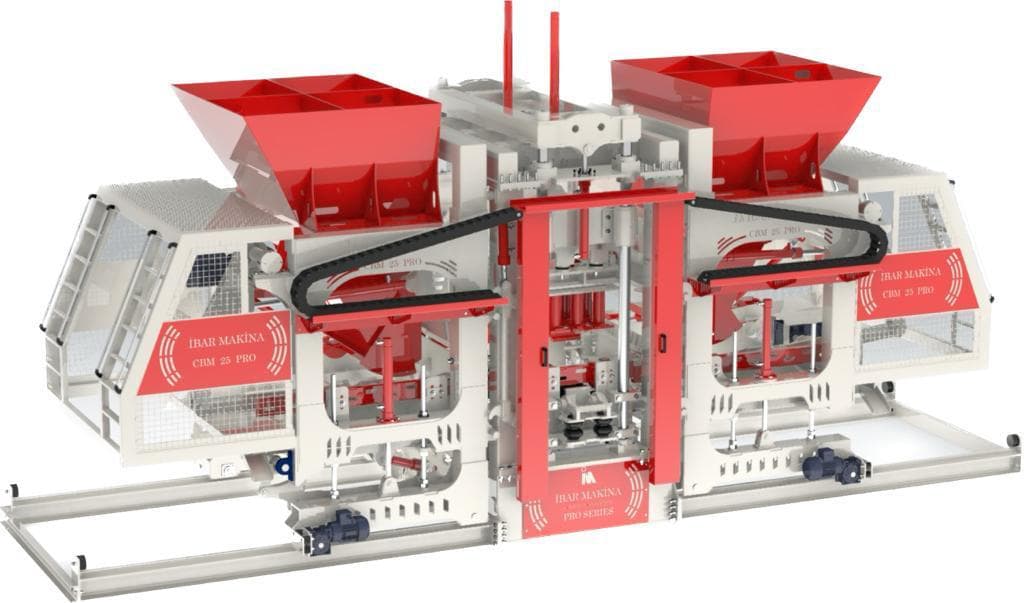
CBM 12-2 is a dual-hopper model specified to produce 4 concrete blocks or 12 paving stones per cycle. However, the number of hoppers alone does not define a complete coloured-product production line. How mix preparation, pigment dosing and feeding are addressed within the quotation must also be clarified.
The impact of mould quantity on the investment budget
A suitable mould is required for each product shape and size. Purchasing a large number of moulds at the outset provides product variety, but allocating budget to options without established sales demand may extend the payback period. A more controlled approach is to identify products expected to receive regular orders first, then invest in additional moulds according to actual demand.
CK45 steel and heat treatment are specified for İBAR MAKİNA's paving stone moulds. When selecting moulds, machine compatibility, product geometry and maintenance conditions are as important as the material. Listing the moulds included in the quotation alongside their product dimensions reduces potential uncertainty about the scope later on.
How Should Daily m² Capacity Be Assessed?
Daily capacity in square metres should be directly linked to sales targets. Pieces per cycle and square metres per day are not the same measure. Without knowing the product's surface area, operating hours and production flow, the number of pieces alone cannot provide a reliable calculation of daily output in square metres. This distinction is particularly important when comparing products of different sizes.
CBM 25-2 is specified to produce 10 concrete blocks or 25 paving stones per cycle, with daily paving stone production of 500 m². This figure is a reference that can be used when assessing the investment. To plan your target production, product dimensions, shift patterns, material feeding and downtime should also be discussed.
When calculating saleable output, mould changes, cleaning, maintenance, quality control and waste must be considered. Sufficient space is also required for curing, storing and preparing the paving stones for shipment. If these processes are not supported proportionately as production capacity increases, the plant's bottleneck may shift to a stage outside the main machine.
What Should You Ask About Installation and Transport Costs?
The machine price must be distinguished from the cost of a plant ready for operation. Transport conditions may vary according to the delivery location, loading arrangements, transport method and shipment scope. For installation, responsibilities for site preparation, equipment positioning, connections and commissioning services should be clearly defined.
- Which delivery point does the quotation cover?
- Which party will provide unloading and lifting equipment?
- How will electrical, ground and other infrastructure preparations be carried out?
- Are installation, commissioning and operator training included in the scope?
- Are auxiliary equipment and production pallets quoted separately?
- Who is responsible for customs clearance and local procedures for international deliveries?
Obtaining written answers to these questions provides a clearer picture of the investment budget. Planning site preparation alongside the shipment schedule also helps reduce potential delays after the equipment is delivered.
Key Considerations for Investment Payback
Payback should not be calculated simply by dividing the total investment by revenue. The calculation should be based on operating cash contribution after deducting raw material, pigment, energy, labour, maintenance, waste and shipment costs. Financing costs and working capital requirements should also be included in the assessment.
- Validate demand: Research local product preferences and the potential for regular buyers.
- Select your product mix: Calculate the costs of grey and coloured products separately.
- Develop a realistic production plan: Account for downtime and the proportion of saleable products.
- Calculate the total investment: Include mould, infrastructure, transport and installation costs.
- Prepare different scenarios: Test the impact of low demand and cost increases.
The highest capacity is not the most suitable investment for every business. A line matched to sales volume can prevent unnecessary investment in excess capacity. On the other hand, a business with steadily increasing orders may consider more extensive automation. The decision should be based on projected sales volumes and actual operating conditions.
Frequently Asked Questions
Why are paving stone machine prices not fixed?
Because automation, hopper configuration, mould quantity, auxiliary equipment and delivery scope vary, a fixed price can be misleading. Reliable pricing is based on a configuration that reflects the defined requirements.
Are dual hoppers always required for coloured paving stones?
This depends on the intended production method. Colouring the entire mix differs from applying a separate coloured surface layer. The hopper and feeding configuration should be selected according to the required product structure.
Should you choose a semi-automatic or automatic system?
Order volume, staffing arrangements, budget and growth targets should be assessed together. The quotation should clearly state which operations are automated; the choice should not be based solely on the model description.
What information is needed for a comparable quotation?
You should provide product dimensions, your preference for grey or coloured production, your daily target in square metres, mould requirements and the installation location. To assess the production line scope suited to your needs, you can send this information to İBAR MAKİNA through the quotation request form.