



Contents
- Key Data for Concrete Block Machine Capacity Calculation
- Calculating Production from Pieces per Cycle and Cycle Time
- Step-by-Step Example: 10 Concrete Blocks per Cycle
- Shift Planning and Accurate Downtime Recording
- How Do Pallets and the Curing Area Affect Daily Capacity?
- The Effect of Staffing and Concrete Feeding on Capacity
- Frequently Asked Questions
Concrete block machine capacity calculation involves more than simply multiplying the number of products per cycle by the daily working time. The number of mould cavities, cycle time, downtime during the shift, concrete feeding arrangements and transfer of products to the curing area must all be considered together. An accurate calculation distinguishes the machine's theoretical output from the plant's sustainable daily production. This allows investment planning, order delivery schedules and operating resources to be aligned with the same production target.
İBAR MAKİNA is a manufacturer that has been producing machinery in Çerkezköy, Tekirdağ since 1978 and exporting to more than 30 countries. When evaluating concrete block machine options for different plant requirements, capacity should be assessed across the entire production flow rather than through a single catalogue figure.
Key Data for Concrete Block Machine Capacity Calculation
The first step is to define the dimensions of the concrete block to be produced and the mould to be used. The same machine can produce different quantities per cycle when operating with different product moulds. Therefore, the quantity specified for one product should not be applied directly to a block of another size. Preparing a separate capacity table for each mould is particularly useful for plants with a wide product range.
- Pieces per cycle: The number of concrete blocks released from the mould in one production cycle.
- Cycle time: The time between two consecutive production cycles, expressed in seconds for the calculation.
- Gross shift duration: The total time between the start and end of a shift.
- Net operating time: The production time remaining after planned and unplanned downtime has been deducted.
- Product acceptance rate: The proportion of produced blocks that pass quality control and qualify as usable products.
Cycle time should not be assessed solely on the basis of vibration or compaction time. All operations that make up the cycle, such as mould filling, compaction, demoulding and pallet advancement, must be considered together. Measurements should be based on a sufficient number of cycles observed under normal production conditions, rather than a few fast cycles.
Calculating Production from Pieces per Cycle and Cycle Time
The basic calculation starts by determining the number of cycles per hour. This figure is then multiplied by the number of products per cycle. Finally, daily production is calculated using the net operating time. Consistent units are important: if the cycle is measured in seconds, one hour is taken as 3.600 seconds in the calculation.
- Cycles per hour = 3.600 / cycle time.
- Theoretical hourly production = cycles per hour × pieces per cycle.
- Net daily production = theoretical hourly production × net operating hours.
- Accepted products per day = net daily production × product acceptance rate.
The theoretical production in these formulas assumes uninterrupted operation. Daily output falls if there are delays due to material availability, cleaning, mould changes or pallet shortages. Even if the machine cycle becomes faster, total plant production may not increase if the mixing and handling equipment cannot keep pace.
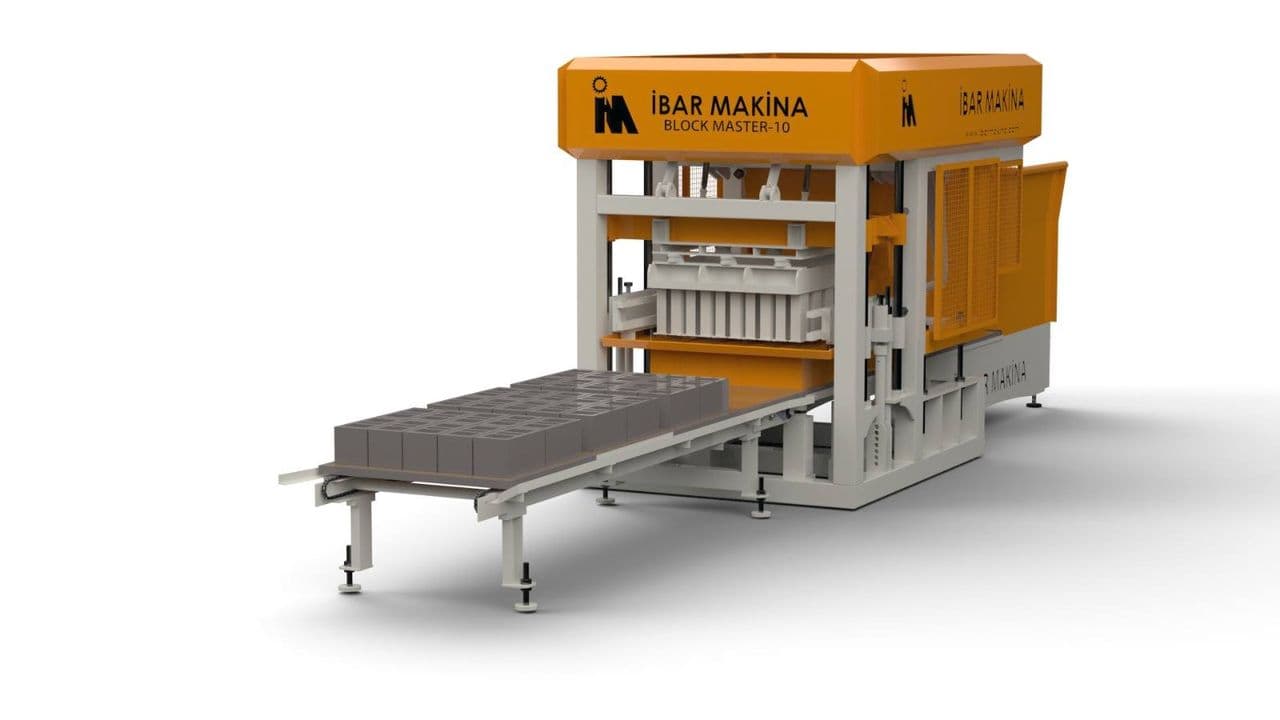
Product specifications must be distinguished from calculation assumptions. For example, the stated figures for the BLOCK MASTER 10 concrete block machine are 10 pieces per cycle and 10.000 pieces per day. However, these figures alone do not establish the exact cycle time or shift duration; operating conditions must be assessed separately at the quotation stage.
Step-by-Step Example: 10 Concrete Blocks per Cycle
The following example uses a hypothetical mould producing 10 concrete blocks per cycle, each measuring 200x400x200 mm. The 36-second cycle and 10-hour shift have been selected solely to illustrate the calculation method; they are not technical cycle or shift specifications for any İBAR MAKİNA model. Mould compatibility and operating parameters must be verified separately for an actual project.
- Determine the pieces per cycle: In this example, 10 concrete blocks are produced in each cycle.
- Calculate the cycles per hour: 3.600 / 36 = 100 cycles/hour.
- Determine the theoretical hourly production: 100 × 10 = 1.000 pieces/hour.
- Calculate the gross shift output: 1.000 × 10 = 10.000 pieces. This is a theoretical scenario with no downtime.
- Deduct downtime: If breaks, cleaning, preparation and waiting total 2 hours in this example, the net operating time is 8 hours.
- Determine the net daily production: 1.000 × 8 = 8.000 pieces. If any products are rejected for quality reasons, the number of accepted products is calculated separately.
In this example, the change in daily output results from reduced available operating time, not a change in the number of pieces per cycle. Similarly, a longer cycle time reduces hourly production. Daily targets should therefore be based on a sustainable average cycle time rather than the fastest observed cycle.
Shift Planning and Accurate Downtime Recording
Shift duration and net production time are not the same. Recording downtime by cause makes it easier for a plant to identify the source of capacity losses. Operator changes, waiting for concrete mix, pallet jams, cleaning and maintenance should be tracked under separate categories. This makes it possible to improve the process that limits production rather than simply extending working hours.
It is important not to deduct the same loss twice in the calculation. For example, if all waiting time has already been deducted from net operating time, a second efficiency factor covering the same delays should not be applied. Quality losses should be assessed separately, because not all products may be suitable for shipment even when the machine has operated and produced them.
When planning multiple shifts, sufficient time must still be allocated for maintenance and cleaning. Automatic concrete block machine options are an important consideration when assessing production flow; however, automation does not automatically eliminate all downtime caused by materials and site organisation.
How Do Pallets and the Curing Area Affect Daily Capacity?
Pallets are one of the key resources that keep the production cycle running. The calculation should consider not only the number of pallets but also how long each pallet remains occupied by products. Assuming that the output of one cycle is placed on one production pallet, the example's 8.000 concrete blocks generate a daily production flow of 8.000 / 10 = 800 pallets. This figure alone does not represent the number of pallets that must be purchased.
The time it takes for pallets to become available for reuse determines the total stock required. If products remain on pallets for longer, more pallets are tied up. Pallets taken out of service for inspection, cleaning or repair must also be considered. It is also important to remember that production pallets and shipping pallets may serve different purposes.
When calculating curing area requirements, daily product volume, residence time in the area, layout and handling aisles must be considered together. Block dimensions alone are not sufficient to determine the space required. Racking systems or different layouts change the usable area. Product handling and stacking methods must also be planned to prevent damage to freshly produced products.
The Effect of Staffing and Concrete Feeding on Capacity
Staffing requirements extend beyond the machine operator. Mix preparation, material feeding, pallet handling, curing area management, quality control and maintenance are also essential to continuous production. Rather than specifying a fixed number of employees, it is more appropriate to assess duties, automation level and site layout together.
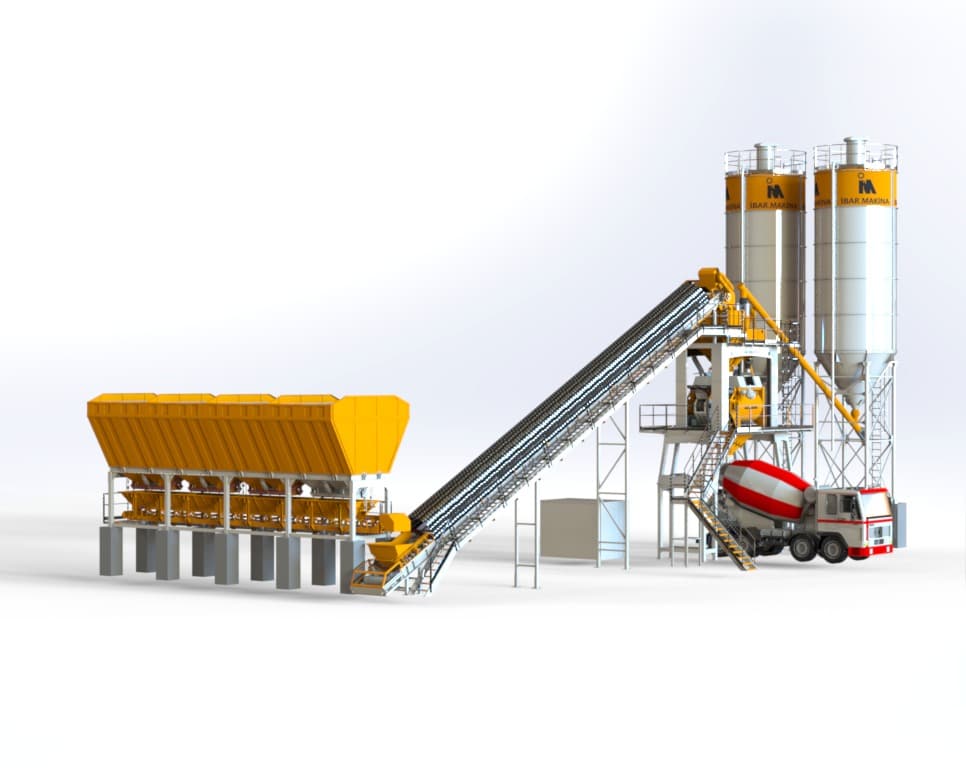
Consistent preparation of the concrete mix also affects cycle continuity. If the machine has to wait for mix, its theoretical capacity cannot be fully utilised. Therefore, concrete batching plant selection should be considered alongside the requirements of the concrete block production line. The batching, mixing and transfer arrangements should support both product quality and production pace.
Frequently Asked Questions
Does the daily capacity stated in the catalogue deliver the same output at every plant?
No. Daily output depends on the product mould, cycle time, net operating time, concrete feeding, pallet turnaround and curing area. When assessing a catalogue figure, the operating conditions on which it is based should be clarified.
Does adding more shifts directly double production?
This target can only be considered if the other resources can accommodate the same increase. If pallet stock, curing space, staffing arrangements or mix preparation capacity are insufficient, adding shifts may not deliver the expected result.
How is the required number of pallets determined?
The daily number of cycles and the time required for pallets to become available for reuse are calculated together. Out-of-service pallets and the plant's reserve requirements are also considered. The number of pallets used daily is not the same as the total pallet stock.
What information is needed for a machine quotation that matches the required capacity?
Product dimensions, target daily production, shift arrangements, available site space, pallet system and automation requirements should be provided. Prices vary according to configuration. To assess the machinery and auxiliary equipment suitable for your project, you can share your requirements with İBAR MAKİNA by completing the quotation form.