



Contents
- What factors affect concrete batching plant prices?
- How should capacity, mixer type and volume be selected?
- Stationary, mobile, compact and site-type plants
- How do the number of silos and automation affect the investment scope?
- How should transport, installation and total investment be compared?
- Frequently Asked Questions
Concrete batching plant prices are not determined solely by whether the plant is stationary or mobile. Production capacity, mixer type and volume, aggregate storage layout, number of silos, automation scope and installation conditions must be assessed together. Two quotations in the same capacity class may not be directly comparable if they include different equipment and services. Making the right choice means identifying a configuration that meets the project's concrete requirements under suitable operating conditions, rather than simply seeking the lowest initial investment. This guide helps you assess plant types and quotation scope against your technical requirements.
What factors affect concrete batching plant prices?
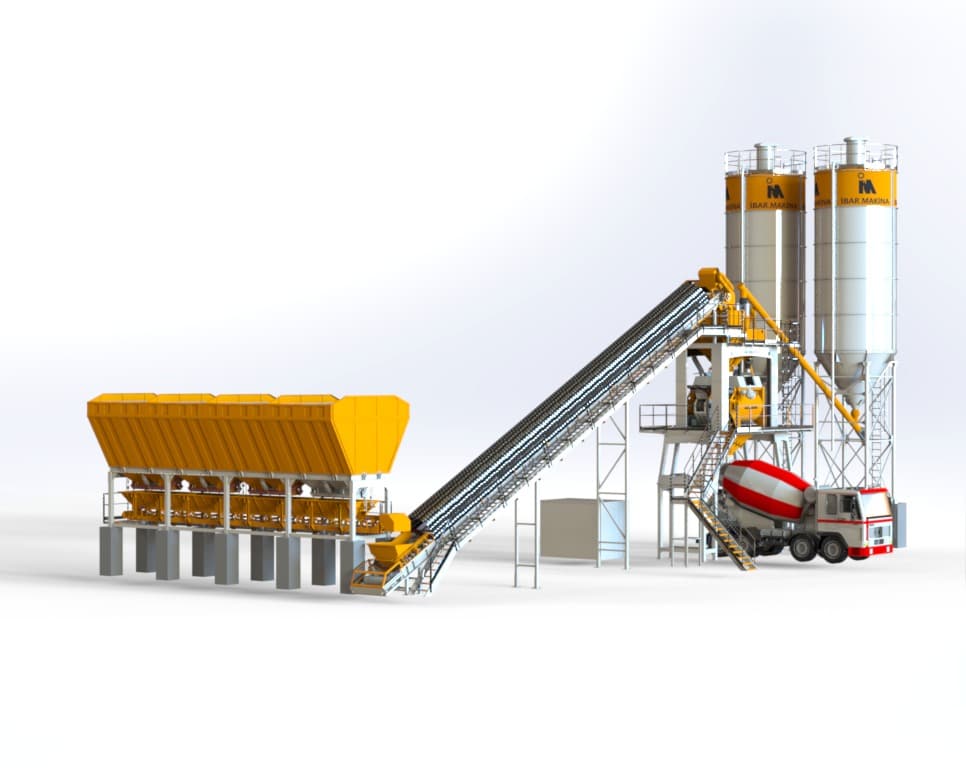
The investment scope of a concrete batching plant includes the main equipment required to prepare concrete and the auxiliary systems that support it. The mixer, aggregate bins, weighing and feeding systems, cement silos and control infrastructure are all part of this scope. However, not every project requires the same layout, storage volume or level of automation. It is therefore important to turn your requirements into a written technical specification before assessing prices.
- Capacity: Hourly concrete requirements and demand during peak pouring periods influence the choice of plant capacity class.
- Mixer: Mixer type, volume and the properties of the concrete to be produced guide equipment selection.
- Storage: The aggregate compartment layout, number of silos and storage requirements affect the overall scope.
- Automation: Mix design management, recording, monitoring and control requirements should be clearly defined in the quotation.
- Site work: Responsibilities for transport, unloading, foundation preparation, assembly and commissioning should be assessed separately.
A more reliable approach is to first review the concrete batching plant options, then narrow down the alternatives based on daily requirements and site conditions. If equipment or services excluded from the quotation become necessary later, the total cost of an option that initially appeared economical may change.
How should capacity, mixer type and volume be selected?
Assess hourly capacity alongside the project schedule
Capacity expressed in m³/hour is one of the key indicators when selecting a plant. However, simply dividing the daily concrete volume by the working hours is not enough. Concentrated pouring periods, changes between mix designs, maintenance breaks and the arrangements for transporting concrete to the site must also be considered. Capacity requirements should be assessed against peak production periods as well as average consumption.
The stated hourly capacity of a product does not mean that the same net output will be achieved under all site conditions. Continuous material feeding, mix design, mixing time and dispatch arrangements can affect actual production. Selecting an unnecessarily high capacity is not always advantageous either; low utilisation can weaken the economic case for the investment.
Do not compare mixer volume alone
Mixer type and volume should be compatible with the concrete mix design and the intended production flow. When assessing different mixer designs, consider the feeding, mixing and discharge arrangements as well as the volume. The quotation should clearly specify the technical definition of the stated volume. For example, the mixer specified for PROMIX 120 is a 3000/2000 L Twinshaft mixer. This should not be interpreted as meaning that other models have the same mixer type or volume.
Stationary, mobile, compact and site-type plants
When selecting a plant type, consider the project duration, likelihood of relocation, available space and consistency of concrete demand together. The examples below show the capacity figures for options in the İBAR MAKİNA product range. These figures alone do not establish a price ranking; the total investment scope depends on the selected equipment and site requirements.
| Plant type | Product example | Stated capacity | Potential application |
|---|---|---|---|
| Stationary | PROMIX 120 | 110 m³/hour | Permanent production site with regular concrete demand |
| Mobile | MOBİL MİX 100 | 100 m³/hour | Project-based production with planned relocation |
| Compact | RAPID 90 | 75 m³/hour | Layout requirements within a more limited space |
| Site-type | MOBİL MİX 30 | 30 m³/hour | Production to meet a project's own concrete requirements |
Which projects are suitable for a stationary plant?
If production will remain at the same location for a long period, concrete demand is regular and the site infrastructure can be planned as a permanent installation, stationary concrete batching plants should be considered. Ready-mix concrete production or a manufacturing facility that uses concrete continuously are applications where this approach may be appropriate. Aggregate storage space, vehicle circulation and dispatch arrangements are as important as future demand when making the selection.
Which projects are suitable for a mobile plant?
If production is expected to move between project sites, mobile concrete batching plants may be a suitable alternative. However, a mobile design does not mean that foundations, power connections or lifting equipment are no longer required. Relocation frequency, transport routes and the scope of dismantling and reinstallation should be included in the technical assessment.
How do compact and site-type options differ?
Compact concrete batching plants can be considered for projects where the plant layout must fit within a more limited space. However, the total site area required for silos, stockpiles and vehicle movements must be calculated separately. For site-type options, the project's own concrete requirements, operating duration and logistics conditions take priority. Since the same model will not suit every project with low or medium demand, a capacity calculation is necessary.
How do the number of silos and automation affect the investment scope?
The number of silos should be determined by the range of cement or other binders to be used, consumption volumes and supply arrangements. Additional silos can help store different materials separately, but they also require extra equipment, connections and site space. Storage capacity should be planned not only according to production capacity, but also with material delivery frequency and continuity in mind.
When assessing automation, clarify how mix designs will be managed, the scope of production records and which operations the operator will control. Including only the phrase “automatic system” in a quotation is not enough. Control hardware, software functions, reporting requirements and training scope should be specified. Automation does not replace correct operation and regular maintenance; it is part of the operating system.
How should transport, installation and total investment be compared?
The plant price and the total investment required for a ready-to-operate facility may not cover the same scope. Transport distance, shipping method, site access and unloading conditions affect costs. Responsibility for items such as foundation preparation, electricity and water connections, assembly equipment, commissioning and operator training should be established at the quotation stage.
- Share your concrete requirements, mix designs, operating hours and project schedule.
- Compare capacity, mixer, storage and automation scope on a like-for-like basis.
- Check whether transport, assembly and site preparation are included.
- Assess maintenance access, spare parts requirements and operating costs.
- Clarify delivery, installation and acceptance conditions in writing.
When discussing your requirements with İBAR MAKİNA, which has been manufacturing in Çerkezköy, Tekirdağ since 1978 and exports to more than 30 countries, share the installation location and production targets. This information helps define a quotation scope that meets the project's needs, rather than simply recommending a plant type.
Frequently Asked Questions
Why is there no single price for a concrete batching plant?
Capacity, mixer, silo configuration, automation and site services vary from project to project. For a meaningful price comparison, these items must be defined within the same technical scope. Prices should therefore be assessed through a quotation tailored to your requirements.
Is a mobile concrete batching plant always more economical than a stationary plant?
No. The economic outcome depends on the operating duration, relocation frequency, production requirements and installation conditions. A long-term operation that will remain in one location should not be assessed using the same criteria as a project that will operate at different sites.
What is the most important information when selecting a site-type plant?
The project's daily concrete requirements and demand during peak pouring periods are the key information. Site area, material supply, power infrastructure and project duration should also be considered. Focusing only on the initial investment can cause capacity or logistics issues to be overlooked.
What information should I prepare to request a quotation?
Sharing your target capacity, concrete types to be produced, installation location, existing site conditions, silo requirements and relocation plans makes the assessment easier. If available, a layout plan and work schedule also help clarify the quotation scope.
To assess the right plant type and investment scope for your project, you can share your requirements with İBAR MAKİNA through the quotation form.