



Contents
- Define your product scope before choosing a concrete pipe machine
- Assess diameter range and pipe length together
- Requirements for reinforced, unreinforced and socket pipes
- Assess box culvert and manhole requirements separately
- Evaluate capacity and automation across the entire line
- Checklist for selecting the right model
- Frequently Asked Questions
Choosing a concrete pipe machine should not be based solely on the maximum pipe diameter. The diameter and length ranges of the products, whether they are reinforced or unreinforced, their joint geometry, daily production targets and plant operating arrangements should all be assessed together. If box culvert and manhole production is also planned, the requirements list should be broader. The right approach is to define the product range first, then match the machine, moulds and auxiliary equipment to that range.
İBAR MAKİNA is a manufacturer that has been producing concrete product manufacturing equipment in Çerkezköy, Tekirdağ since 1978 and exports to more than 30 countries. This guide helps you define a clear scope for your technical requirements before investing and compare models using the same criteria.
Define your product scope before choosing a concrete pipe machine
The first step is to list each product you intend to manufacture on a separate line. Include not only current orders but also foreseeable requirements for new products. However, rather than choosing an oversized system simply because it might be useful in the future, align your growth plan with demand and your investment budget.
- Product type: Concrete pipe, box culvert or manhole element.
- Dimensions: Pipe diameter, pipe length, wall thickness and external product dimensions.
- Structural characteristics: Reinforced or unreinforced production and the required reinforcement geometry.
- Joint type: Socket, gasket groove and mating joint details.
- Production plan: Target quantities by product, shift arrangements and product changeover frequency.
This information establishes a common technical basis for evaluating concrete pipe machine options. Two products with the same nominal diameter may differ in length, wall thickness or joint design. Diameter compatibility alone is therefore not a sufficient selection criterion.
Assess diameter range and pipe length together
When selecting a machine, the distribution of orders within the diameter range is just as important as the smallest and largest diameters to be produced. Identifying the diameters that will be produced most frequently allows for more realistic planning of mould investment, changeovers and production flow. For a technical comparison, product drawings should also clarify which dimension the nominal diameter refers to.
| Model | Specified pipe diameter range | Specified additional scope |
|---|---|---|
| CPM 800 | 150–800 mm | Pipe length and product details must be verified separately |
| CPM 1400 | 300–1400 mm | Pipe length and product details must be verified separately |
| CPM 1600 PRO | 300–1600 mm | 1000–2500 mm pipe length |
| CPM 2400 | 300–2400 mm | Box culverts up to 2000x2000 mm |
| CPM 3600 | 600–3600 mm | Box culverts up to 3000x3000 mm |
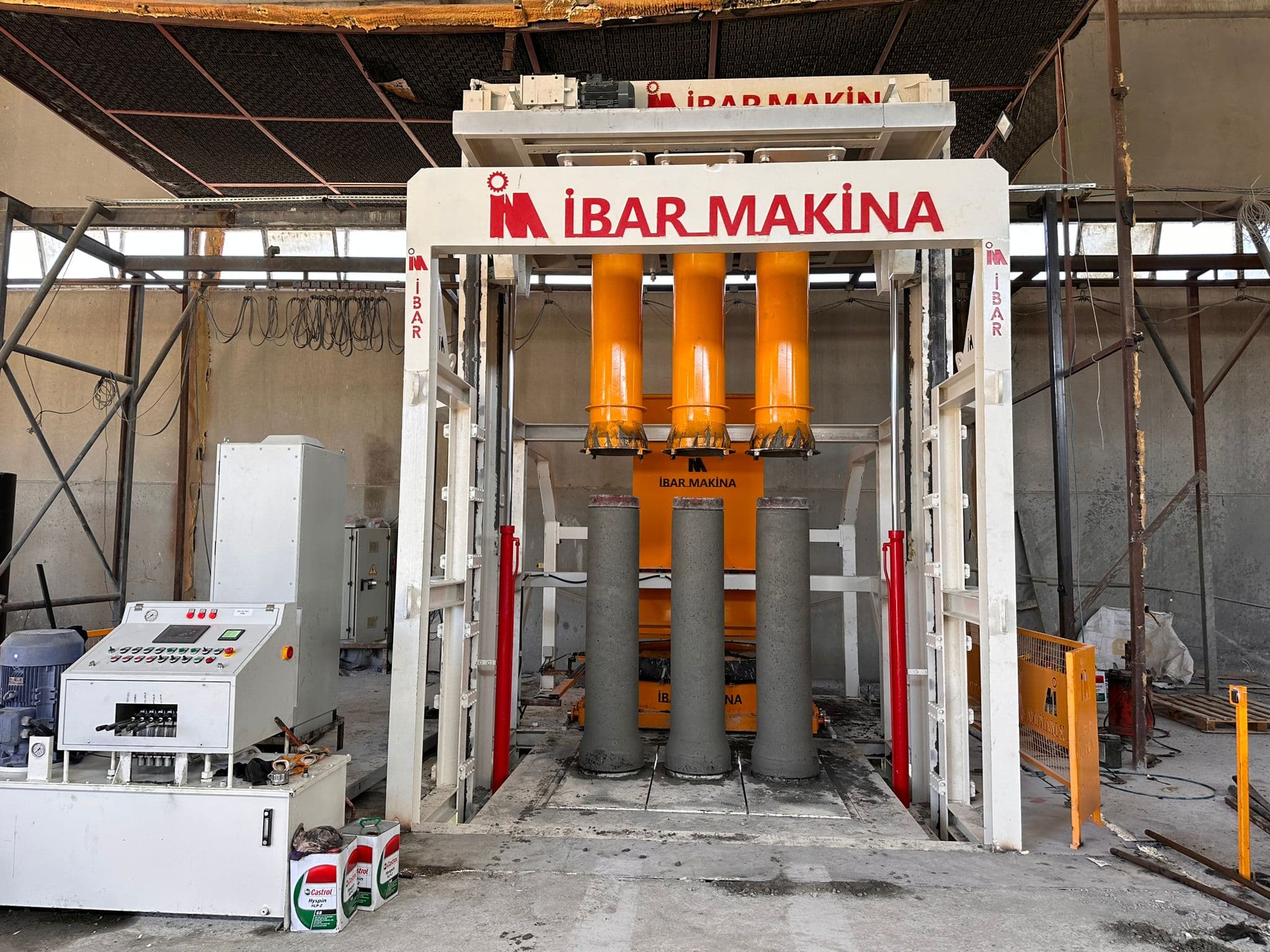
For example, the CPM 1600 PRO concrete pipe machine can be assessed against its specified diameter and length ranges. However, the limits in the table do not mean that every combination of diameter, length, wall thickness and joint design is automatically suitable. Final suitability must be confirmed against the product drawings and the selected mould configuration.
Requirements for reinforced, unreinforced and socket pipes
How does the reinforcement cage affect production flow?
In reinforced pipe production, preparing, handling and positioning the reinforcement cage in the mould are part of the production plan. Cage dimensions, concrete cover, fixing methods and access for placement should be considered together. Delays in these preparations, even when separate from the machine cycle, can make it difficult for the line to achieve its target production rate.
For unreinforced products, the concrete mix, compaction, demoulding and handling conditions remain important. Reinforcement requirements should not be determined solely by the choice of machine; they should be based on the product's intended use, project specifications and relevant technical requirements. The suitability of the selected model for the target product should be explicitly confirmed with the manufacturer.
Define the socket and gasket groove on the drawing
For socket pipe requirements, diameter and length information alone is not sufficient. The socket geometry, its connection to the opposite end of the pipe, gasket use and required dimensional tolerances should all be included in the mould assessment. As joint details may vary between customers, sharing a cross-sectional drawing at the quotation stage reduces incorrect assumptions.
It should not be assumed that different joint types can be produced on the same machine. The required mould components, changeover method and demoulding conditions should each be discussed separately. This helps prevent a mismatch between the machine order and the product's technical requirements.
Assess box culvert and manhole requirements separately
Box culvert production requires different mould geometry and handling considerations from circular pipe production. The internal cross-section, external dimensions, wall thickness, product length and reinforcement layout should all be specified together. Particularly for large elements, lifting equipment, access routes within the plant and storage space should also be included in the investment scope.
The specified scope for the CPM 2400 concrete pipe machine covers 300–2400 mm pipes and box culverts up to 2000x2000 mm. For the CPM 3600, the stated scope covers 600–3600 mm pipes and box culverts up to 3000x3000 mm. All dimensions and production conditions for the planned culvert must be verified separately.
If manhole production is required, this product range should be assessed separately. The specified diameter range for the CMM 1200 manhole machine is 620–1200 mm. The lengths, connection details and mould requirements of the elements to be produced should be included in the quotation scope. It should not be assumed in advance that a pipe machine can produce all manhole elements.
Evaluate capacity and automation across the entire line
Production capacity is not determined solely by the machine's operating cycle. Concrete preparation and feeding, reinforcement placement, mould changes, product removal, handling and curing space all affect the line's total output. Daily targets should therefore be provided by product, together with the planned shift conditions.
Production times should not be assumed to be the same for different diameters and lengths. In a plant with frequent product changeovers, mould change times, preparation work and initial product inspections are important planning factors. When comparing capacity, the target product, operating time and auxiliary equipment scope should be the same.
The level of automation should also be defined according to your requirements. Ask which operations will be automatic, where operator intervention will be needed and which records the control system is expected to provide. Automation does not eliminate the need for suitable concrete feeding, trained personnel and regular maintenance.
Checklist for selecting the right model
- Prepare product drawings: Show diameter, length, wall thickness and joint details.
- List your product mix: Distinguish regularly produced products from occasional orders.
- Explain reinforcement requirements: Define the arrangements for cage preparation and placement.
- Specify additional products: List box culvert and manhole requirements separately.
- Define capacity conditions: Relate target quantities to shifts and product types.
- Check the plant layout: Assess concrete feeding, lifting, curing and storage areas.
- Compare quotation scopes: Clarify moulds, auxiliary equipment, automated operations and installation scope.
- Confirm suitability: Request an assessment of the selected model against your product drawings.
Prices vary according to machine configuration, mould scope, automation level and auxiliary equipment. Comparisons should therefore be based on the same technical scope, not just the total price.
Frequently Asked Questions
Is a machine that meets the largest diameter requirement the right choice?
Not on that basis alone. The smallest diameter, pipe length, joint geometry, reinforcement requirements and predominant product mix should also be assessed. The model's suitability for the intended product combinations must be confirmed using technical drawings.
Can reinforced and unreinforced pipes be produced on the same machine?
Suitability must be assessed according to the model, mould and product characteristics. For reinforced production, cage placement and fixing conditions are also important. Both product groups should be clearly specified in the quotation request.
Is a pipe machine also sufficient for box culverts and manholes?
This cannot be assumed for every model. The specified box culvert scope should be compared with the product dimensions, while manhole requirements should be assessed separately. Mould and handling requirements should also be considered together.
What information should be prepared to request a quotation?
Prepare product drawings, diameter and length ranges, reinforcement and socket details, daily production targets, shift arrangements and the plant layout. Use this information to complete the quotation form and ask İBAR MAKİNA to assess the machine, mould and equipment scope best suited to your requirements.