



Contents
- Why is paving stone mould maintenance important?
- How should daily cleaning be carried out?
- What signs should be monitored during wear inspections?
- How do correct vibration and pressing settings protect the mould?
- The effect of aggregate selection on mould service life
- Advantages of heat-treated CK45 steel moulds
- How is the right time for mould replacement determined?
- Frequently Asked Questions
Paving stone mould maintenance involves more than cleaning at the end of production. It is a regular maintenance discipline that preserves the mould's dimensional accuracy, surface condition and compatibility with the machine. Assessing concrete residue, unsuitable aggregate, incorrect vibration and pressing settings together provides a clearer understanding of the causes of wear. Planned maintenance helps maintain product quality and reduce unexpected downtime. Operator checks, maintenance records and manufacturer instructions should therefore be managed within a single system.
Why is paving stone mould maintenance important?
In paving stone production, the mould determines the shape of the concrete mix and the basic geometry of the product. Material accumulating in mould cavities or wear on surfaces can cause changes in the stone's edges, height and surface appearance. These symptoms are not always caused solely by the mould. Mix moisture, feeding arrangements and machine settings also affect the outcome. Maintenance assessments should therefore be carried out alongside product inspections.
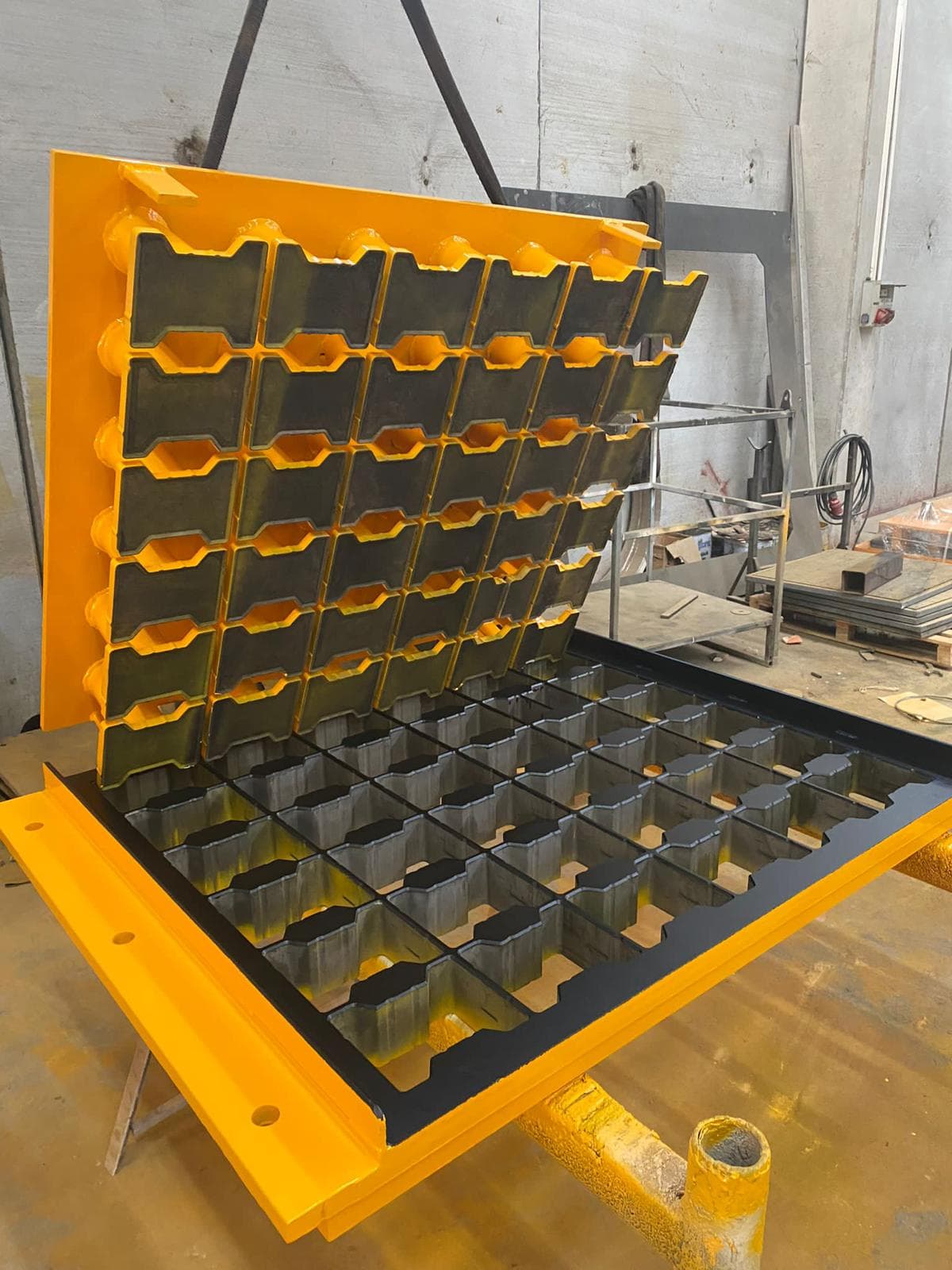
Regular inspections help identify minor build-up and connection problems before they escalate. The aim is not to use the mould for as long as possible, but to maintain acceptable product quality safely and consistently. For options suited to different product geometries, you can explore our paving stone mould range. The maintenance plan should be based on the construction of the mould in use and the production conditions.
How should daily cleaning be carried out?
Before cleaning, the machine must be stopped safely, energy sources isolated according to the manufacturer's instructions, and moving parts secured against unexpected operation. Only authorised personnel should access the mould area. Hands or cleaning equipment must not be inserted into the mould while production is in progress. Once safe access has been established, the mould cavities, tamper elements and areas around connections can be inspected.
Removing fresh concrete residue before it hardens makes cleaning easier. Use equipment approved by the manufacturer that will not scratch the surface. Striking the steel surface forcefully or grinding indiscriminately can compromise dimensional accuracy and surface condition. Chemical cleaners should only be used once their compatibility with the mould material and the application method have been confirmed. Uncontrolled application of acidic products is not an appropriate maintenance method.
- Check for concrete build-up in mould cavities and corners.
- Remove residue from the contact surfaces of the tamper elements.
- Inspect connection areas for looseness or trapped material.
- If wet cleaning is suitable, dry the surfaces afterwards.
- Apply the manufacturer's recommended corrosion protection method before storage.
A brief visual inspection after cleaning can reduce problems at the next production start-up. If a protective product has been applied, ensure that no unwanted residue remains on surfaces in contact with concrete when the machine is put back into operation. Record the cleaning method and materials used in the maintenance log.
What signs should be monitored during wear inspections?
Wear assessment should not rely on visual inspection alone. Measurement records compared with initial dimensions help reveal how changes are progressing. Mould cavities, corner areas, tamper elements and connection points should be inspected together. Measurement frequency can be determined according to production intensity, aggregate characteristics and previous maintenance findings. Acceptance limits should be based on product requirements and the mould manufacturer's technical assessment.
| Inspection point | Signs to monitor | Assessment |
|---|---|---|
| Mould cavities | Dimensional changes or uneven surface wear | Compare with reference dimensions. |
| Corners and edges | Rounding, breakage or cracks | Assess product geometry and safe operation. |
| Tamper elements | Uneven contact or surface damage | Assess alignment and wear together. |
| Connection points | Looseness or deformation | Check the connection arrangement according to the manufacturer's instructions. |
If products show recurring edge defects at the same location or dimensional variations, the mould should be inspected. However, feeding, concrete moisture and compaction conditions should also be checked before deciding to replace the mould. This helps prevent unnecessary replacement of a sound mould or masking genuine wear through adjustments.
How do correct vibration and pressing settings protect the mould?
Vibration and pressing allow the concrete to settle and compact inside the mould. Applying excessive mechanical loads does not always produce a better product. Unsuitable settings can increase loads on the mould, tamper elements and connections. Insufficient compaction, on the other hand, can adversely affect product integrity and surface quality. The correct approach is to make balanced adjustments within the operating limits specified by the machine manufacturer.
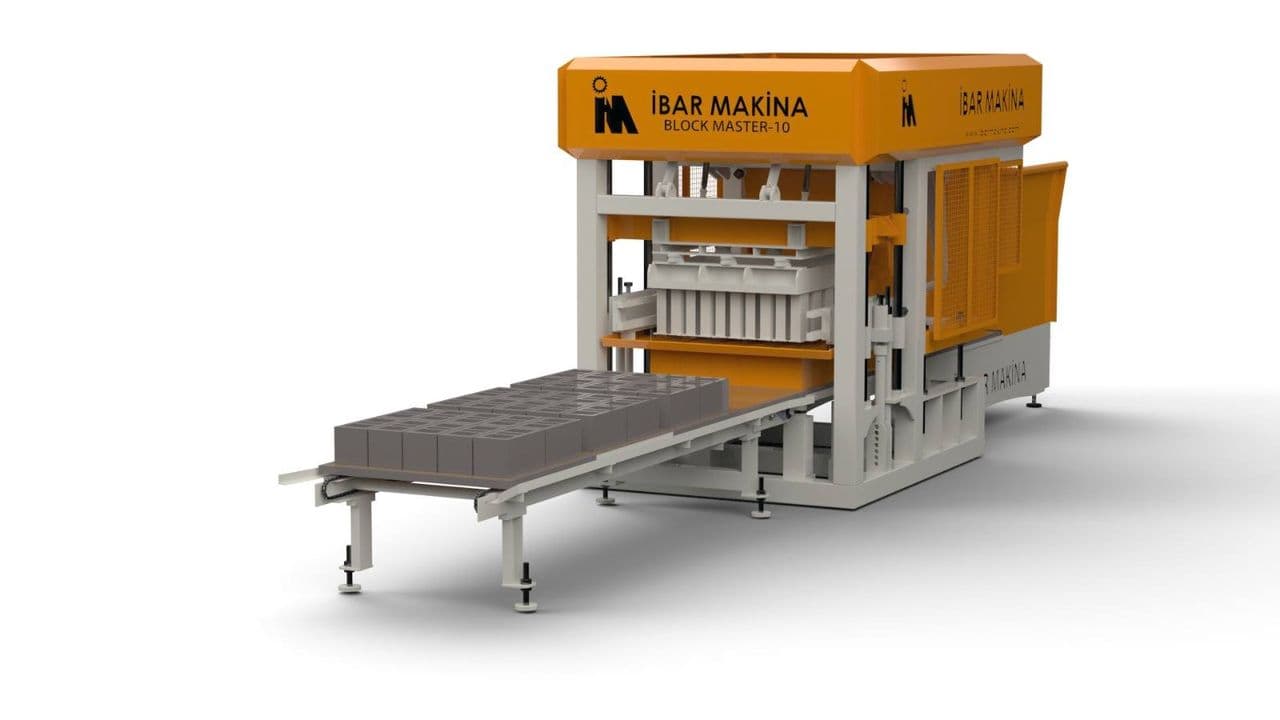
A single vibration or pressing setting is not suitable for every paving stone geometry and concrete mix. Mould construction, product height, mix behaviour and feeding arrangements should be assessed together. Adjustments should be made under controlled conditions, and the results verified through product measurements and quality checks. Compatibility between the paving stone machine and the mould is just as important to production as maintenance.
If unusual noise, increased vibration or uneven pressing marks are detected, production should not continue simply by increasing the settings. Check that the mould is seated correctly, inspect the connections and verify the alignment of the tamper elements. Recording setting changes makes it easier to understand the conditions under which problems occur.
The effect of aggregate selection on mould service life
Aggregate is the concrete component that repeatedly comes into contact with mould surfaces. Particle size distribution, hardness, particle shape and its proportion in the mix can affect wear behaviour. In particular, oversized particles that do not meet the mix specification or foreign material can cause production irregularities and localised stresses. Aggregate selection should therefore not be based solely on procurement cost.
Use a particle size distribution suited to the target product's characteristics, and monitor aggregate cleanliness and consistency. Moisture changes should also be monitored because they affect concrete feeding and compaction. When switching to a new aggregate source, do not assume that the existing settings will produce the same results. Controlled production trials and product inspections help assess both quality and the effects on the mould.
Advantages of heat-treated CK45 steel moulds
İBAR MAKİNA's paving stone moulds are manufactured from CK45 steel and heat-treated. Properly performed heat treatment helps the steel achieve hardness and strength properties suited to its operating conditions. These properties are important for mould performance under repeated production loads and abrasive contact.
However, steel grade and heat treatment alone do not guarantee a specific service life. Mould design, production conditions, aggregate characteristics and maintenance practices all contribute to the outcome. Even on a heat-treated mould, uncontrolled welding, grinding or surface modifications should not be carried out. When repairs are needed, the method should be reviewed with the manufacturer.
How is the right time for mould replacement determined?
Mould replacement should not be decided solely on elapsed time or appearance. Dimensional accuracy, product quality, the nature of the damage and safe operating condition should be considered together. An inability to maintain acceptable product dimensions, recurring geometric defects or cracks affecting safety require technical assessment. Not all damage should be assumed to be repairable.
- Clean the mould to distinguish problems caused by build-up.
- Compare measurements with reference records.
- Check machine settings, alignment and mix conditions.
- Assess with the manufacturer whether the damage requires repair or replacement.
- After replacement, verify product conformity through controlled production.
İBAR MAKİNA has been manufacturing in Çerkezköy, Tekirdağ, since 1978 and exports to more than 30 countries. Sharing product geometry, photographs of the existing mould, machine details and measurement records helps define requirements more accurately for a mould assessment.
Frequently Asked Questions
Should a paving stone mould be cleaned every day?
Mould inspection and appropriate cleaning are recommended at the end of daily production. The rate of build-up can vary depending on production conditions. Cleaning frequency should be adjusted according to the manufacturer's instructions and observations made at the facility.
Can a fixed service life be specified for a mould?
It is not appropriate to specify a fixed period that applies to every facility. Aggregate, production intensity, settings, mould construction and maintenance routines affect service life. Replacement decisions should be based on measurement and quality records.
Does increasing vibration compensate for a worn mould?
Increasing vibration does not restore a worn surface or altered geometric dimensions to their original condition. Unnecessary increases in load can lead to new problems. First, determine whether the issue originates from the mould, the mix or the settings.
What information should be shared when requesting a quotation for a new mould?
Share the machine model, the shape and dimensions of the stone to be produced, details of the existing mould and production expectations. Prices vary according to mould geometry and configuration. You can contact İBAR MAKİNA by completing the quotation form to discuss a solution suited to your operation.