




Contents
- The recipe: how many blocks from one bag of cement?
- Our assumptions
- Cost per 9-inch block in five cities
- Selling price and profit per 9-inch block
- 6-inch blocks
- Profit by machine size: 4,000, 8,000 or 10,000 blocks a day
- Port Harcourt: how to raise the profit
- 30 mm or 25 mm shells?
- Quality: the Nigerian standard and building collapses
- Demand: who buys the blocks?
- Electricity or diesel?
- Which machine for which volume?
- What this calculation does not include
- Sources for the prices
- Frequently asked questions
Short answer: yes, block making is profitable in Nigeria when the blocks are made by machine and you get many blocks from each bag of cement. With 30 mm block shells our calculation gives a margin of about 44–59% on a 9-inch block in Lagos, about 27–42% in Abuja, Kano and Ibadan, and 35–48% in Port Harcourt if you buy cement by the truckload and chippings straight from the quarry. Hand-moulded blocks at a 1:8 mix leave very little margin at today's cement price. A yard with an 8,000-block machine running at full capacity and selling its full output makes about US$22,000–65,000 a month, depending on the city.
This guide uses the same method as our general guide is a block making business profitable: a real production recipe from one of our customers, plus local prices for cement, sand, stone dust, labour and diesel in five Nigerian cities. You can repeat every step with your own prices.
Download the presentation (PDF, 5 pages): the same calculation as a presentation with the BLOCKMASTER 4, 8 and 10, to print or share.
The recipe: how many blocks from one bag of cement?
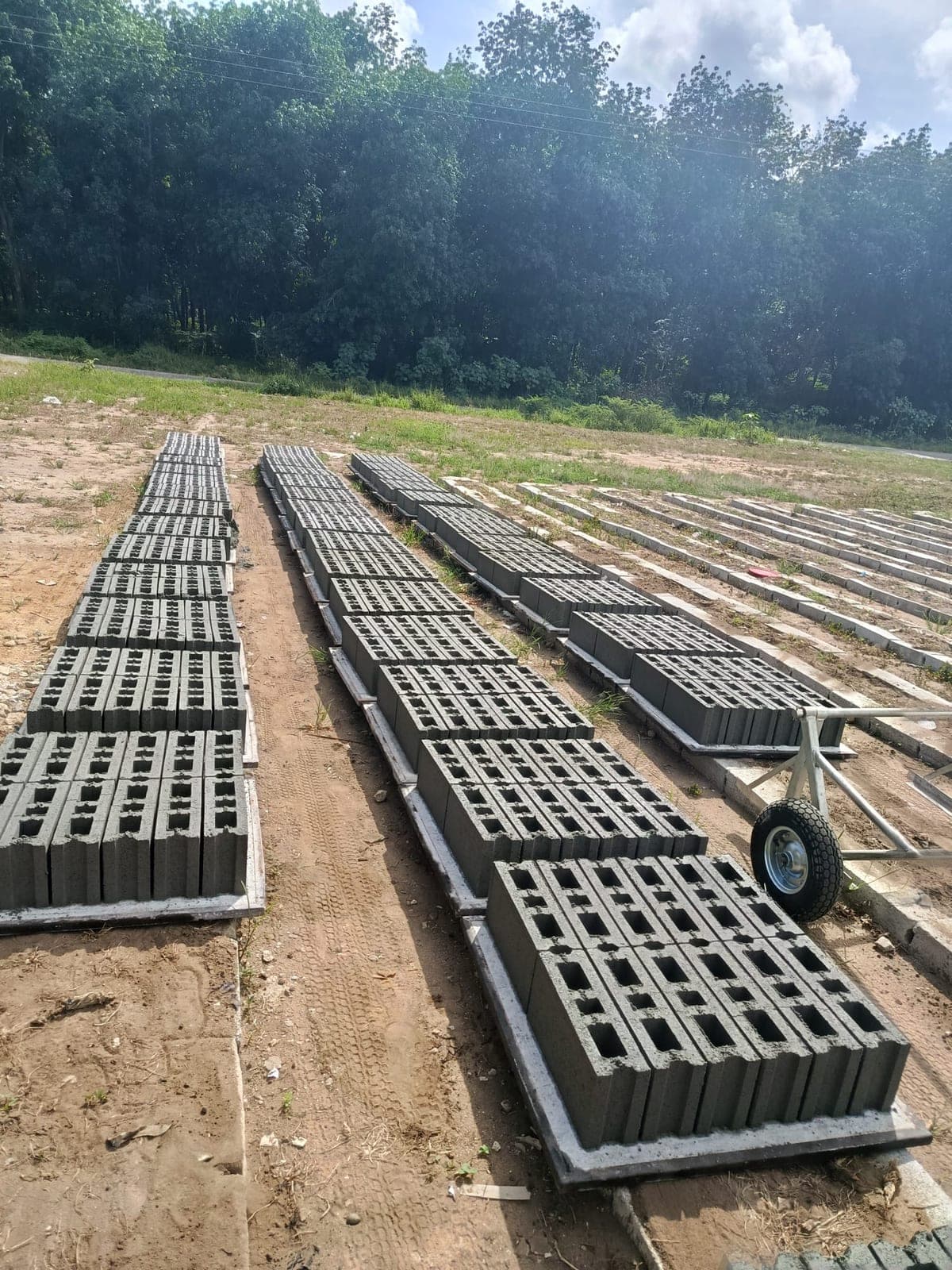
One of our customers in Ghana made 7,500 hollow blocks of 150×400×200 mm with 30 mm shells, using 120 bags of cement, 55.5 m³ of sand and 37 m³ of chippings. That is 62.5 blocks per 50 kg bag.
Machine-made blocks in Nigeria are usually 400×200 mm on the face: a 6-inch block is 150 mm wide, exactly like the Ghana block, and a 9-inch block is 225 mm wide. For the 9-inch block we scale the recipe by its concrete volume, keeping the same 30 mm shells and two cores:
| Block | Size (mm, length×height×width) | Blocks per bag, 30 mm shells | Blocks per bag, 25 mm shells |
|---|---|---|---|
| 9-inch hollow | 400×200×225 | about 52 | about 60 |
| 6-inch hollow | 400×200×150 | 62.5 | about 73 |
For comparison, Nigerian guides give about 18–25 hand-moulded sandcrete blocks per bag at a 1:8 mix. Thick, hand-tamped shells use far more cement than a block that is vibrated and pressed in a steel mould. If a buyer or a project specification asks for thicker shells, the yield falls: with 50 mm shells a 9-inch block gives only about 34 blocks per bag.
Our assumptions
- A BLOCKMASTER 4 or CBM 12 with a crew of 8, making 4,000 9-inch blocks a day (5,000 6-inch blocks).
- The machine runs at full capacity, six days a week, 26 days a month, and the yard sells its full output.
- A generator burning about 45 litres of diesel a day.
- 6% added for water, curing, maintenance, about 3% breakage and small costs.
- Monthly profit is cautious: it uses the low end of the selling price range, 5% material waste, 30% higher pay for skilled operators, 10% other costs and about US$1,500 a month of fixed costs (manager, security, rent, maintenance).
- ₦1,360 to the US dollar. Prices are what we found at the time of writing; they change, so check yours.
Cost per 9-inch block in five cities
| City | Cement (50 kg) | Sand per m³ | Stone dust / chippings per m³ | Labour per day | Diesel per litre | Cost per block |
|---|---|---|---|---|---|---|
| Lagos | ₦12,500 | ₦17,000 | ₦25,000 | ₦8,000 | ₦1,790 | ≈₦614 |
| Abuja | ₦13,000 | ₦10,600 | ₦27,300 | ₦7,000 | ₦1,900 | ≈₦578 |
| Kano | ₦13,000 | ₦10,000 | ₦22,000 | ₦5,500 | ₦1,850 | ≈₦535 |
| Port Harcourt | ₦12,500 (by the truckload) | ₦15,000 | ₦14,000 (from the quarry) | ₦6,000 | ₦1,950 | ≈₦524 |
| Ibadan | ₦12,000 | ₦13,000 | ₦23,000 | ₦5,500 | ₦1,850 | ≈₦548 |
Cement is about 40% of the cost of a block, sand and stone dust together about 50%. Labour and diesel are only about ₦32–36 per block at 4,000 blocks a day, so a machine that keeps output high is what makes the numbers work.
Selling price and profit per 9-inch block
| City | Selling price | Profit per block | Margin | Profit per month, BLOCKMASTER 4 (4,000 a day) |
|---|---|---|---|---|
| Lagos | ₦1,100–1,500 | ₦486–886 | 44–59% | ₦42.5 million (≈US$31,200) |
| Abuja | ₦800–1,000 | ₦222–422 | 28–42% | ₦15.4 million (≈US$11,300) |
| Kano | ₦750–900 | ₦215–365 | 29–41% | ₦15.1 million (≈US$11,100) |
| Port Harcourt | ₦800–1,000 | ₦276–476 | 35–48% | ₦21.6 million (≈US$15,900) |
| Ibadan | ₦750–950 | ₦202–402 | 27–42% | ₦13.7 million (≈US$10,100) |
Monthly figures are cautious: they use the low end of the price range and the extra costs listed in our assumptions. Lagos stands out because vibrated, stone-dust blocks there sell for ₦1,100–1,500 while ordinary blocks sell for ₦600–1,100. In the other cities the price gap between machine-made and hand-moulded blocks is smaller, so the profit depends more on cement per block and on daily volume.
Lagos
The biggest market and the best prices for quality blocks. Sand and stone dust are expensive (a 30 t trip of stone dust costs about ₦600,000 delivered), so buying full trucks and storing aggregates on site matters. Sell to contractors and estate developers who pay for strength and uniform size.
Abuja
Cement is among the most expensive in the country (Dangote about ₦13,100, BUA about ₦12,800 a bag), but sharp sand is cheap at about ₦136,500 per 20 t load. Government and private estates keep demand steady; a yard close to the new estates on the edge of the city saves delivery costs.
Kano
Labour is the cheapest of the five cities and block prices are lower. Kano also has the largest housing deficit in the country according to the federal housing ministry. The grid is the weakest of the five, so plan to run the machine and mixer on a generator.
Port Harcourt
Cement often costs ₦14,000 or more a bag in town, and granite chippings are trucked in from Cross River, so prices vary widely. A serious yard buys cement by the truckload (about ₦12,500 a bag) and chippings straight from the Akamkpa quarries (about ₦9,200 a tonne delivered, or ₦14,000 per m³); our figures assume you do. Bought from town dealers, chippings can cost twice as much and the cost per block rises to about ₦660. See how to raise the profit in Port Harcourt below.
Ibadan
Cement is cheaper than in Abuja and Port Harcourt (distributors sell from about ₦10,550 a bag) and 9-inch blocks sell for ₦750–950, or more for vibrated stone-dust blocks. Charging separately for delivery, which costs ₦20,000–120,000 per trip in the city, protects your margin.
6-inch blocks
The 6-inch block is the same block as in the Ghana recipe, so 62.5 blocks per bag. With 30 mm shells it costs about ₦507 in Lagos, ₦476 in Abuja and ₦452 in Ibadan. At selling prices of ₦850–1,100 in Lagos, ₦600–880 in Abuja and ₦550–850 in Ibadan, the margin is about 40–54%, 21–46% and 18–47%. Many yards make both sizes on the same machine with a mould change.
Profit by machine size: 4,000, 8,000 or 10,000 blocks a day
With a bigger machine, labour and diesel are spread over more blocks. Monthly profit on 9-inch blocks with 30 mm shells, where each machine runs at full capacity and the yard sells its full output, at the low end of the price range, 26 working days a month (six days a week), with 5% material waste, 30% higher pay for skilled operators, 10% other costs and fixed costs of about US$1,500, 2,500 and 3,000 a month (manager, sales, security, rent, maintenance and mould wear):
| City | BLOCKMASTER 4 / CBM 12 (4,000 a day) | BLOCKMASTER 8 / CBM 20 (8,000 a day) | CBM 25 (10,000 a day) |
|---|---|---|---|
| Lagos | ₦42.5 million (≈US$31,200) | ₦88.1 million (≈US$64,800) | ₦111.1 million (≈US$81,700) |
| Abuja | ₦15.4 million (≈US$11,300) | ₦33.8 million (≈US$24,900) | ₦43.3 million (≈US$31,900) |
| Kano | ₦15.1 million (≈US$11,100) | ₦33.0 million (≈US$24,300) | ₦42.3 million (≈US$31,100) |
| Port Harcourt | ₦21.6 million (≈US$15,900) | ₦46.1 million (≈US$33,900) | ₦58.8 million (≈US$43,200) |
| Ibadan | ₦13.7 million (≈US$10,100) | ₦30.1 million (≈US$22,200) | ₦38.7 million (≈US$28,500) |
We assume a crew of 8, 11 and 14 people and about 45, 70 and 70 litres of diesel a day; our 8,000 and 10,000-block machines burn about the same diesel. Outputs are for 200 mm blocks; ask us for the 9-inch mould output of each model. These are cautious figures: the low end of the price range and cautious costs.
Port Harcourt: how to raise the profit
In Port Harcourt everything depends on where you buy cement and chippings, and the cautious figures are a floor, not a forecast. Here is what a yard with a BLOCKMASTER 8 or CBM 20 (8,000 blocks a day) gains step by step. Each line keeps the changes above it:
| Step | Cost per block sold | Profit per month |
|---|---|---|
| Starting point: the BLOCKMASTER 8 / CBM 20 row of the machine-size table above | ₦562 | ₦46.1 million (≈US$33,900) |
| Use 25 mm shells, if your blocks still pass the strength test | ₦484 | ₦62.4 million (≈US$45,900) |
| Sell at the middle of the price range (₦900): uniform, tested blocks | ₦484 | ₦83.2 million (≈US$61,200) |
Together with the machine-size table above, this shows the range from a cautious floor to what the best yards in Port Harcourt achieve.
30 mm or 25 mm shells?
Some block makers use 25 mm shells. A 9-inch block then needs about 15% less concrete, so you get about 60 blocks per bag instead of 52:
| City | Cost per 9-inch block, 30 mm shells | Cost per 9-inch block, 25 mm shells | Margin, 25 mm shells |
|---|---|---|---|
| Lagos | ≈₦614 | ≈₦529 | 52–65% |
| Abuja | ≈₦578 | ≈₦499 | 38–50% |
| Kano | ≈₦535 | ≈₦461 | 39–49% |
| Port Harcourt | ≈₦524 | ≈₦451 | 44–55% |
| Ibadan | ≈₦548 | ≈₦473 | 37–50% |
At 4,000 blocks a day that is about ₦8.2–9.6 million more profit per month. Thinner shells also mean a weaker block, so only use them if your blocks still pass the strength test below and your buyers accept them.
Quality: the Nigerian standard and building collapses
The Nigerian Industrial Standard for sandcrete blocks, NIS 87, asks for an average compressive strength of at least 2.5 N/mm² for 6-inch blocks and 3.45 N/mm² for 9-inch load-bearing blocks. Field studies in Lagos, Ibadan and Kaduna found most market blocks below this level, and a study by the Nigerian Building and Road Research Institute names substandard materials as the main cause in about a third of building collapses. Have a few blocks from each new mix tested at a materials laboratory, and keep the results: contractors and estate developers increasingly ask for them, and good results let you sell in the higher price band.
Demand: who buys the blocks?
- The federal government puts the housing deficit at about 15 million homes.
- The Renewed Hope Cities and Estates programme has received more than 100,000 applications, with estates in Abuja (Karsana, about 2,400 homes), Kano (Janguza, about 1,000 homes) and Lagos (about 2,004 homes).
- Private estates, churches, schools and shops build all year in every city; the rainy season slows sales for a few months.
Electricity or diesel?
Band A customers on the grid pay about ₦209–225 per kWh and are promised at least 20 hours of supply a day. According to the electricity regulator, self-generation with diesel costs about ₦800 per kWh. A Band A connection is therefore much cheaper if your area has one, but outages are common in all five cities, so most yards keep a generator for the machine and mixer. Our cost table assumes diesel only.
Which machine for which volume?
- Up to about 4,000–5,000 blocks a day: BLOCKMASTER 4 or CBM 12. The egg-laying MBM4 works without pallets.
- About 8,000–10,000 blocks a day: BLOCKMASTER 8 or CBM 20.
- About 10,000–12,000 blocks a day and paving stones: CBM 25, or the fully automatic CBM 25 PRO.
Machine capacities are quoted for 400×200 mm blocks; ask us for the 9-inch and 6-inch mould output of the model you are considering. For the full start-up plan (site, permits, crew and customers), see how to start a block making business in Nigeria; for daily output, see block machine capacity calculation.
What this calculation does not include
- Land, rent, buildings and a curing area.
- Delivery trucks and fuel for delivery.
- Depreciation, taxes, permits and loan repayments.
- Unsold stock and slow months in the rainy season.
Sources for the prices
- Cement: Legit.ng dealer surveys, Buildocrat (Abuja), Daily Trust (Kano), CemNet.
- Blocks, sand and stone dust: Mypricespot, NigeriaBuildingCost, Buildocrat, Structurecity, Amapha, Jiji listings.
- Labour: BuildWithEase, Buildocrat. Diesel: GlobalPetrolPrices, Awajis, PetroleumPrice.ng.
- Standard and collapses: Structville (NIS 87), NBRRI, COREN. Housing: Federal Ministry of Housing and Urban Development, Daily Trust, ThisDay. Electricity: NERC via BusinessDay.
- Prices for Kano, Port Harcourt and Ibadan come from fewer sources than Lagos and Abuja; treat them as estimates.
Frequently asked questions
How much profit per block in Nigeria?
With machine-made 9-inch blocks and 30 mm shells: about ₦486–886 in Lagos, ₦222–422 in Abuja, ₦215–365 in Kano, ₦276–476 in Port Harcourt and ₦202–402 in Ibadan, using the prices in this guide.
How many 9-inch blocks from one bag of cement?
About 18–25 when hand-moulded at 1:8. With a machine, a 400×200×225 mm block and 30 mm shells about 52, and with 25 mm shells about 60, based on a real recipe from one of our customers.
Which city is best for a block business?
Lagos gives the highest margins because quality blocks sell at ₦1,100–1,500. Abuja, Kano and Ibadan give smaller margins per block but steady demand. In Port Harcourt, buy cement by the truckload and chippings straight from the quarry; then it pays as well as Abuja or Kano.
Is a block business profitable with hand moulding?
Barely. At about 20–25 blocks per bag, cement alone costs ₦500–650 per 9-inch block, close to the selling price of ordinary blocks in most cities.
Does İBAR MAKİNA install the machine in Nigeria?
Yes. On-site installation and operator training are included in the price, machines carry a 2-year warranty and spare parts are shipped from stock on the same day.
Send us your city, the blocks you want to make and your target daily output on WhatsApp, and we will recommend a machine and run these numbers with your local prices.